
Software teams rarely wake up one morning and decide they need “more DevOps”. They notice releases taking longer, production problems becoming harder to diagnose, cloud costs drifting upwards or experienced developers spending too much time maintaining delivery infrastructure.
A DevOps consultancy can help when these problems are important enough to fix but do not justify building a complete platform team from scratch. The right engagement should improve how software is built, released and operated while leaving your own team more capable and in control.
This guide explains the signs that external support may be useful, the difference between hiring a consultancy, a freelancer or a permanent employee, and what a good DevOps engagement should actually deliver.
What should a DevOps consultancy solve?
DevOps is often presented as a collection of tools: cloud platforms, containers, deployment pipelines, infrastructure as code, monitoring and security scanners. Those tools can be useful, but installing them is not the business outcome.
The outcome is a safer and more predictable route from an approved code change to a working production service. That may mean making releases routine, recreating environments reliably, finding incidents sooner or giving developers a clearer way to operate the systems they build.
A consultancy should therefore begin with the delivery problem rather than a preferred technology. A team with a stable application and occasional releases may need a straightforward pipeline and better monitoring. A growing platform with several services may need stronger environment management, observability and operational ownership. Neither automatically needs Kubernetes, a complex internal platform or a large transformation programme.
Six signs that external DevOps support may be useful
Releases depend on a few people
If only one or two people understand how to deploy the application, every release carries avoidable risk. Holidays, competing priorities and staff changes can quickly turn that knowledge gap into a business constraint.
The immediate need is not simply automation. The deployment process should be understandable, repeatable and protected by appropriate reviews and controls.
Production changes feel unusually stressful
A release should not require a long checklist, several manual hand-offs and an evening reserved for emergency fixes. When changes are large and infrequent, teams receive feedback later and each release becomes harder to reason about.
Smaller changes, automated checks and a rehearsed rollback path can reduce the amount of uncertainty surrounding production delivery.
Environments do not behave consistently
“It worked in testing” is often a sign that environments have drifted apart. Servers may have been changed manually, configuration may live in several places or important dependencies may not be versioned.
Infrastructure as code and controlled configuration can make environments more reproducible. The goal is not infrastructure automation for its own sake; it is confidence that the same change will behave consistently as it moves towards production.
Incidents take too long to understand
Monitoring that only reports whether a server is running tells you little about whether customers can complete an important task. Useful observability connects technical signals with real service behaviour.
Teams need enough logging, metrics, tracing and alerting to answer practical questions: What changed? Which users are affected? Is the problem getting worse? Can we restore service safely?
Cloud spending has no clear owner
Cloud costs often grow through many individually reasonable decisions. Old environments remain active, resources are oversized, data transfer is poorly understood or every new workload receives a different solution.
A focused review can make spending visible and identify waste, but cost control must remain connected to reliability and product needs. The cheapest infrastructure is not useful if it makes the service fragile or slows the team down.
Product work is repeatedly blocked by platform decisions
Developers should not need to redesign the delivery system whenever they add a service, create an environment or change a scheduled task. Repeated platform questions consume senior engineering time and produce inconsistent answers.
External support can establish a small set of sensible patterns that cover the work the team actually performs. The best result is a paved route that makes the safe option easy without preventing engineers from handling unusual cases.
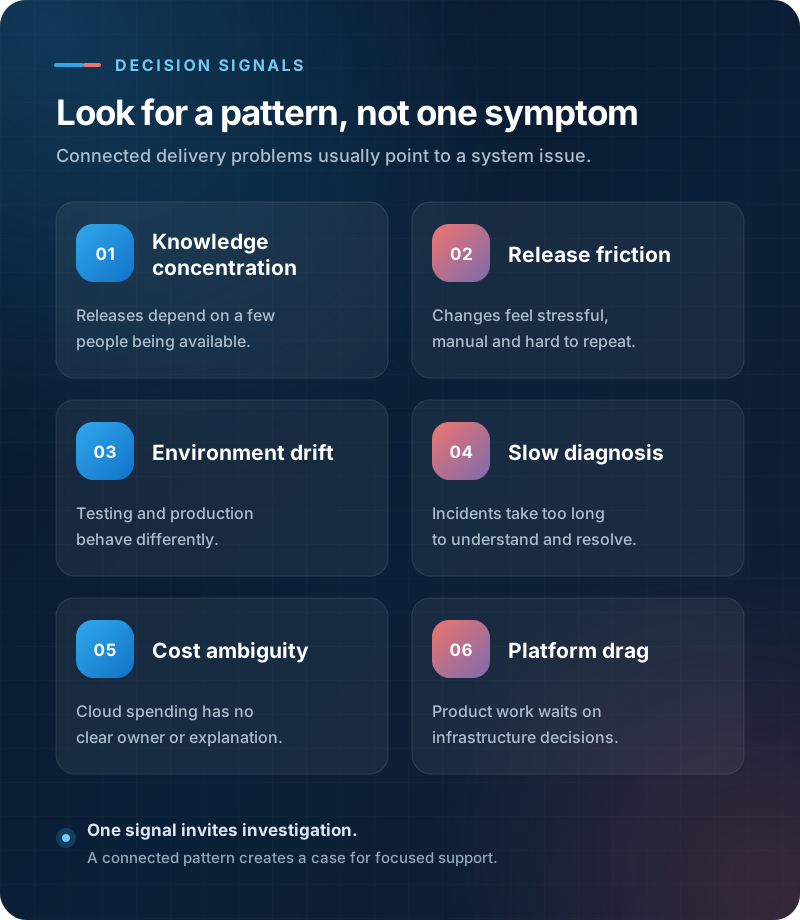
Several connected signals usually justify external support more strongly than one isolated inconvenience.
DevOps consultancy, freelancer or permanent hire?
The right source of support depends on the duration of the problem, the range of skills required and who will own the platform afterwards.
| Option | Best suited to | Main advantage | Important consideration |
|---|---|---|---|
| DevOps consultancy | A defined improvement involving assessment, implementation and handover | Can combine senior delivery, cloud, security and operational experience | Confirm who will do the work and what your team will own afterwards |
| Freelance DevOps consultant | A focused piece of work with clear scope and strong internal ownership | Direct access to an individual specialist | Availability and continuity may depend on one person |
| Permanent hire | Long-term platform ownership with a steady pipeline of work | Builds knowledge and accountability inside the company | Recruitment takes time and one hire may not cover every specialism |
| Managed service | Ongoing operation of a clearly defined platform or service | Provides continuing operational capacity | Make responsibilities, access, exit arrangements and escalation paths explicit |
These options can also work together. A consultancy might stabilise delivery and create a roadmap while a permanent hire is recruited. A freelancer may be ideal for a well-bounded migration when an internal technical lead already owns the wider architecture.
If you are considering external engineering support more broadly, our guide to software outsourcing in 2026 explains how to divide responsibilities without losing product ownership.
What a good DevOps engagement should deliver
A baseline tied to business priorities
The first output should be a shared understanding of the current delivery system: how changes reach production, where delays occur, which failures matter most and what constraints the team must respect.
This prevents the engagement from becoming a collection of unrelated technical improvements. It also gives leadership and engineers the same definition of success.
A prioritised and proportionate plan
Not every weakness deserves immediate investment. A useful plan separates urgent risks from valuable improvements and optional future work. It should also explain dependencies, trade-offs and the expected impact of each stage.
The smallest valuable change might be securing deployment credentials, automating one fragile release path or adding alerts around a critical customer journey. Early improvements should reduce risk while creating evidence for the next decision.
Working changes, not only recommendations
Unless the engagement is explicitly an assessment, it should leave behind working improvements: tested pipelines, version-controlled infrastructure, useful dashboards, clear access controls or a more reliable release process.
Documentation matters, but it should describe a system the team has used and reviewed. A large report cannot replace functioning automation and shared operational experience.
Security built into delivery
The route to production is a powerful part of the software system. It handles source code, dependencies, credentials and access to live environments.
A responsible engagement should review who can change the pipeline, how code is approved, where secrets are stored, what automated checks run and how production deployments are triggered. Security controls should support regular delivery instead of appearing as a separate inspection at the end.
Knowledge transfer and a clear exit
Your team should be able to understand, operate and improve the result. That requires joint implementation, practical documentation, runbooks, walkthroughs and opportunities for your engineers to make changes themselves.
The consultancy should also make the exit path clear. Repositories, infrastructure definitions, accounts and operational knowledge should remain under your control. A successful engagement reduces dependency rather than creating a new one.
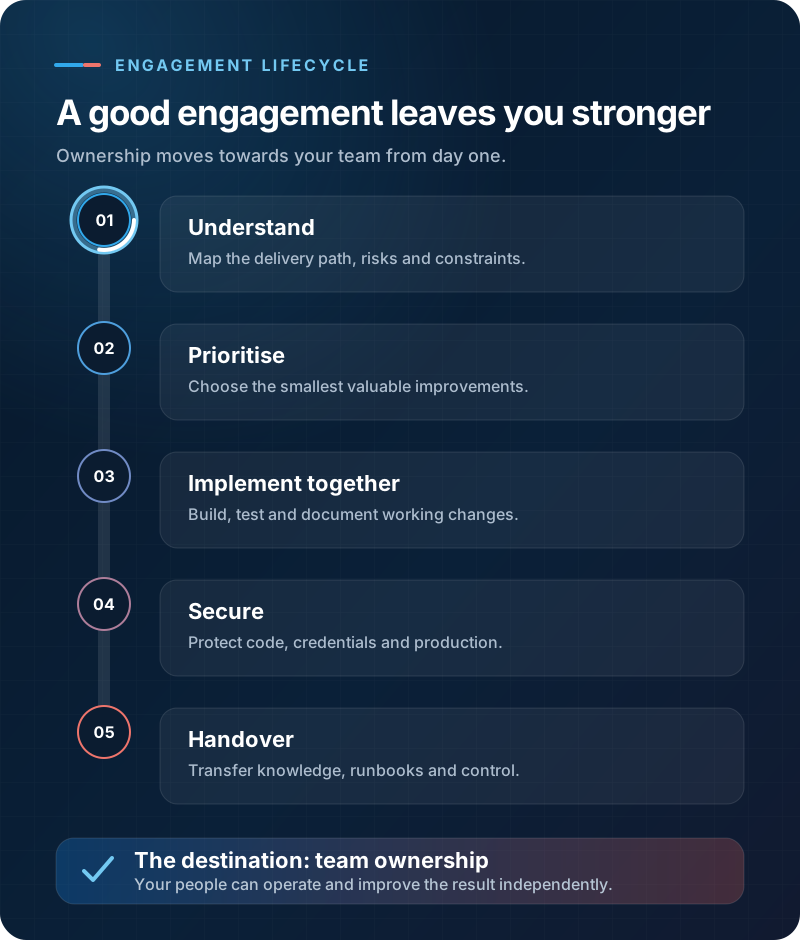
The work should move towards team ownership from the beginning, rather than treating handover as a final-day activity.
Measure improvement in terms the team can use
Tool installation is easy to count but rarely proves that delivery has improved. A better set of measures follows the flow of work and the behaviour of the live service.
Depending on the problem, useful questions include:
- How long does an approved change take to reach production?
- How often can the team release safely?
- What proportion of releases require urgent correction or rollback?
- How quickly can the team restore service after a failed change?
- How much engineering time is spent on manual deployment and environment work?
- Can the team identify which customers and workflows are affected by an incident?
- Is cloud spending visible, attributable and reviewed regularly?
The starting values do not need to look impressive. Their purpose is to show where the delivery system is improving and where another bottleneck has become visible.
Questions to ask before choosing a DevOps consultancy
A credible partner should be comfortable discussing constraints and responsibility, not only capabilities. Before agreeing an engagement, ask:
- What problem would you investigate first, and why?
- Who will perform the work, and how senior are they?
- What should be working by the end of the first stage?
- How will you measure whether delivery has improved?
- How will our engineers participate and learn during implementation?
- Which repositories, accounts and documentation will we own?
- How do you protect source code, credentials and production access?
- What ongoing support is genuinely necessary after handover?
- Which technologies would you avoid adding to our current system?
- How can either side end the engagement safely?
Pay attention to the questions the consultancy asks in return. They should want to understand your product, users, team, risk tolerance, compliance needs and current operating model. A proposal based only on your cloud provider and tool list is unlikely to address the real constraint.
Start with a focused assessment
You do not need a company-wide DevOps transformation to improve one important delivery path. A short assessment can map how a critical service moves from code to production, identify the largest risks and produce a staged plan that fits the team you have.
That creates a useful decision point. You can implement the plan internally, bring in a specialist for a defined task or ask a consultancy to deliver the highest-value changes alongside your engineers.
DuniaOps provides hands-on DevOps and cloud consultancy for UK software teams that need safer releases, reproducible infrastructure, clearer operations or focused senior support. We begin with the delivery problem, recommend the smallest sensible intervention and design the work for practical handover.